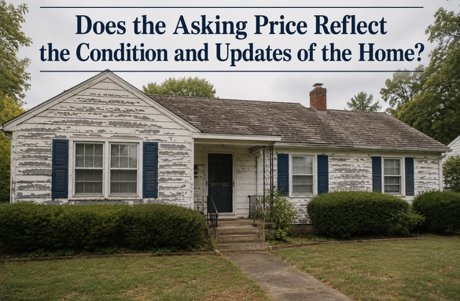
One of the most common misunderstandings we see in real estate involves the relationship between a home's asking price, its condition, and its level of updating.
Buyers often walk through a home and immediately begin making a mental list of everything they would like to repair, replace, or update. Before long, they're estimating thousands of dollars in improvements and wondering how much less they should offer.
On the other side of the transaction, sellers are often surprised when buyers point out repairs, outdated features, or deferred maintenance and use those items to justify a lower purchase price.
So who's right?
The answer is... it depends.
The real question isn't simply "What does this home need?" A better question is, "Has the seller already taken those items into consideration when establishing the asking price?"
Condition and Updates Are Not the Same Thing
One of the first things buyers and sellers should understand is that a home's condition and its level of updating are two different things.
A home may be in excellent condition but still feel outdated to today's buyers. The roof may not leak, the heating and cooling system may work well, and the kitchen cabinets may have been carefully maintained for decades. Yet buyers may still view those features as dated compared to other homes on the market.
Likewise, a home with modern paint colors, updated flooring, and a renovated kitchen may still have maintenance issues that aren't immediately obvious.
Both condition and updates influence value, but they do so in different ways.
Looking at It from the Buyer's Perspective
It's perfectly reasonable for buyers to consider the cost of repairs or future improvements when deciding what a home is worth to them. However, buyers should be careful not to assume that every home needing work is automatically overpriced.
Some sellers intentionally price their homes below comparable updated properties because they know the buyer will eventually need to replace flooring, remodel a bathroom, or update the kitchen. In those cases, the asking price may already reflect the home's condition and level of updating.
Other sellers may overestimate what their home is worth because they've become accustomed to its condition or don't fully recognize how today's buyers will view it.
The challenge for buyers is determining which situation they're looking at. That's where an experienced real estate professional can provide valuable guidance.
Another factor buyers should consider is that improvements usually can't simply be added to a conventional mortgage. While certain renovation loan programs are available, they often involve additional requirements and aren't the right fit for every buyer. As a result, many buyers would rather pay more for a move-in-ready home than purchase one requiring immediate improvements after closing.
Looking at It from the Seller's Perspective
One of the hardest things for any homeowner to do is look at their home through the eyes of a buyer.
You've lived there for years. The small imperfections no longer catch your attention. The bathroom may function perfectly, even if it hasn't been updated in decades. The kitchen may be spotless and well maintained, even if the cabinets and countertops are no longer what many buyers are looking for.
Buyers don't have those memories.
They see the home for the very first time, and they're comparing it to every other property they've toured or viewed online. They're considering not only what the home is worth today, but also how much time and money they'll likely invest after they move in.
Even when a home is priced appropriately for its condition and level of updating, it may still appeal to a smaller group of buyers than a similar home that's been recently updated. Many buyers simply don't have the extra cash available for improvements after closing, while others prefer the convenience of purchasing a home that's ready to enjoy from day one. Because of that, homes needing repairs or updates often take longer to sell than comparable move-in-ready homes, even when they're priced fairly.
Price Isn't the Only Factor
Another important point that buyers and sellers sometimes overlook is that agreeing on a fair purchase price doesn't guarantee a smooth transaction.
Some loan programs have minimum property condition requirements and may require certain repairs to be completed before closing. Something as simple as peeling or chipping paint may need to be repaired before the lender will approve the loan.
Homeowners insurance can also play a significant role. In today's insurance market, many companies carefully evaluate the age and condition of a home's roof before issuing a policy. An older roof may still be functioning well and show no signs of leaking, yet an insurance company may still require it to be replaced before providing coverage or may limit the coverage they are willing to offer.
Even cash buyers are often affected because most still want homeowners insurance to protect one of their largest investments.
These factors don't necessarily determine what a home is worth, but they can influence which buyers are able to purchase it and how smoothly a transaction proceeds.
Pricing Is More Than Looking at Comparable Sales
Many people believe pricing a home is simply a matter of looking at recent comparable sales. Comparable sales are certainly one of the most important tools, but they don't tell the whole story.
Experienced real estate professionals also consider the home's condition, level of updating, location, age, features, buyer demand, and competing properties currently on the market.
It's also important to understand that remodeling costs and market value aren't always the same. Spending $30,000 on improvements doesn't automatically increase a home's value by $30,000. Likewise, a buyer's estimate of $30,000 in future updates doesn't necessarily justify reducing the purchase price by that same amount.
Pricing a home requires experience, judgment, and a thorough understanding of the local market.
The Value of Experienced Guidance
Whether you're buying or selling, one of the most valuable services a real estate professional provides is helping you understand how the market views a particular property.
For buyers, that means knowing when a home is already priced fairly—even if it needs some work—and recognizing when the asking price doesn't accurately reflect the home's condition or level of updating.
For sellers, it means receiving honest advice before the home ever goes on the market. Sometimes making a few improvements before listing will result in a quicker sale and a higher selling price. Other times, it makes more financial sense to sell the property as it is and adjust the asking price accordingly.
Every property is different, and every situation deserves careful evaluation.
The Bottom Line
The asking price of a home should reflect far more than its size or location. Condition, updates, buyer demand, financing requirements, insurance considerations, and current market conditions all play a role in determining both value and marketability.
Buyers shouldn't assume every home needing repairs deserves a significantly lower offer, and sellers shouldn't assume buyers will overlook deferred maintenance or outdated features simply because the home has been well cared for over the years.
The goal isn't simply to negotiate a price. It's to arrive at a price that fairly reflects the property and today's market while helping both buyers and sellers make informed decisions with confidence.
At Bay River Realty, we're committed to helping our clients understand the market from both perspectives. Whether you're preparing to buy, thinking about selling, or simply wondering how today's market views your home, we're always happy to share our experience and provide honest, practical advice