


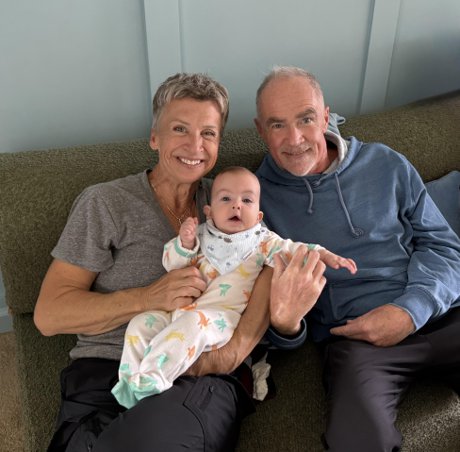
“Don’t try to change the Northern Neck. They got it right.”
Don and Michele came to the Northern Neck looking for a slower life.
After decades spent raising children, moving across the country and overseas, working long hours, and living at a fast pace, they wanted water, quiet mornings, open skies, and room to breathe.
What they found was something even better. They found home.
And when life took an unimaginable turn, they discovered just how deeply this community knows how to love people through hard times.
“Move to the Northern Neck and be like the Northern Neck,” Don says. “They got it right–-don’t try to change it.”
That conviction comes from experience.
Don grew up in the Bronx, New York, in a two-bedroom apartment with hardworking parents who taught him never to apologize for building a better life. Michele taught first grade before staying home to raise their three children, later returning to work in schools as a permanent substitute.
Their life together carried them from Missouri—where they met at the University of Missouri—to St. Louis, Detroit, Peru, Northern Virginia, and countless places in between during Don’s 34-year law enforcement career. He served first as a police officer in St. Louis before spending 27 years with the DEA.
The work was demanding. Long hours. Call-outs. Travel. Sacrifice.
“We ran our cars into the ground,” Michele says with a laugh. “We never thought we’d end up with a beautiful place like this.”
But eventually, after years of hard work and careful saving, they began dreaming about retirement. Somewhere peaceful. Somewhere on the water. When they found their home in Westmoreland County in 2021, they knew almost immediately.
Actually, Don knew before they even bought the house.
“He bought a 13-foot Boston Whaler before we even had a house,” Michele laughs. “His brother said it was like buying a built-in pool before you even own the home.”
But Don already saw the life he wanted. Fishing at sunrise. Running the river with the dog. Exploring Shark Tooth Island. Golfing. Walking trails. Drinking coffee on the dock.
“This was what I always wanted,” he says. “Just a little room.”
What surprised them most, though, was the people.
“The people around here really got it right,” Don says. “They’re super nice. Super friendly. Welcoming.”
Michele remembers a woman in her Bunco group saying something that perfectly captured how they felt.
“We were all introducing ourselves as ‘from here’ or ‘come here,’” she says. “And one woman simply said, ‘I’m blessed to be here.’ And we all thought, yes… that’s exactly it.”
Then, last November, everything changed.
Don had always been active. He worked out hard, carried his golf bag instead of using a cart, spent hours outside, and rarely slowed down. So when he started getting short of breath, neither of them immediately thought the problem was serious.
At the time, Michele was in Michigan helping their daughter after the birth of their grandson, Lucas. Don had stayed behind briefly in Virginia, planning to join them soon.
Even then, he almost didn’t go to Urgent Care. Like many active people who rarely get sick, Don was used to pushing through discomfort. He assumed the shortness of breath was something minor—maybe pneumonia—and planned to “tough it out.”
But there was one thing bothering him. He wanted to meet his new grandson.
“I wasn’t worried about myself,” Don says. “I just wanted to get medicine so I could feel better and go meet my grandson.”
“If Lucas hadn’t been born, he never would’ve gone to Urgent Care,” Michele says. “He would’ve pushed through it, like always.”
So instead of ignoring the symptoms, he drove himself to Urgent Care in Tappahannock, expecting antibiotics and a quick trip back home. An EKG raised concerns, and he was rushed to the hospital before eventually being transferred to VCU Medical Center in Richmond.
Doctors soon realized this was not a typical heart attack. Don had developed giant cell myocarditis, a rare and aggressive disease that attacks the heart. So rare, in fact, that only a tiny number of cases are diagnosed worldwide each year.
Within hours, their world turned upside down. Doctors told Michele and Don’s family that although he appeared physically strong, he was the sickest patient on the floor.
Machines took over for his failing heart. Emergency procedures followed. He suffered strokes, complications, bleeding, kidney damage, infections, and multiple major surgeries.
At one point, he was placed on ECMO, a machine that circulates blood outside the body when the heart can no longer function well enough on its own. Eventually, surgeons implanted an artificial heart while they waited for a donor heart to become available.
Through it all, Don’s family stayed close. So did his sense of humor.
Even in the middle of unimaginable circumstances, he found himself connecting with nurses, encouraging hospital staff, practicing Spanish with a cleaning woman each morning, and somehow making the people around him laugh.
“There were hard things,” Michele says. “But there were also beautiful things.”
One morning, Don told a hospital employee how much her smile mattered to him.
“You don’t know what it means to people like me,” he told her. “If she can smile, I’ll smile.”
Then came another difficult moment. A donor heart became available, and everyone prepared for surgery. But after personally examining the heart, Don’s surgeon made the difficult decision to turn it down.
“He told us, ‘I think you deserve a better heart,’” Don says.
Not long after, another heart became available. The transplant took place the night before Thanksgiving. By Thanksgiving morning, Don had a new heart.
Recovery, however, would still be long.
After weeks of sedation, surgeries, and medications, Don experienced severe ICU delirium—a medically common but deeply frightening condition where vivid hallucinations and confusion blur reality.
To help ground him, Michele and their children covered his hospital room walls with photographs of home: family pictures, the river, their dock, and the steep staircase leading from the water up to their house.
Sixty steps. Those stairs became the goal.
“At Sheltering Arms, everybody knew about the 60 steps,” Michele says. “The nurses and therapists were determined to get him back to that dock.”
And Don was equally determined. Even when he could barely move, he worked. He exercised in bed. Counted reps. Pushed for one more. Fought through setbacks.
“I’m nothing special,” he says. “I just want to live. I will never quit.”
After 82 days away, Don finally came home. Back on the water. Back with Michele. Back drinking coffee in the mornings and taking the dog out on the boat.
And deeply grateful.
Grateful for VCU. Grateful for Sheltering Arms. Grateful for the donor family whose loss gave him life. Grateful for every nurse, therapist, friend, neighbor, and stranger who prayed for him.
And grateful for the Northern Neck.
During Don’s recovery, local businesses checked on them constantly. Their roofer told Michele not to worry about payment until Don was home. Their dentist hugged him when he returned for the first time after surgery. Friends brought meals, prayed, texted, and showed up.
“This community just knows how to care for people,” Michele says.
Don agrees.
“I think people here have figured out how to live,” he says. “Not perfectly. But genuinely.”
These days, he says people often ask him if the experience changed him. In some ways, yes. But not in the dramatic, movie-scene kind of way people expect. Instead, it sharpened what already mattered most: family, gratitude, perseverance, purpose, and people.
“I told God, ‘If you let me live, you won’t waste your time with me,’” Don says. “I’ll fight for it.”
And he has.
One step at a time.
All 60 of them.