


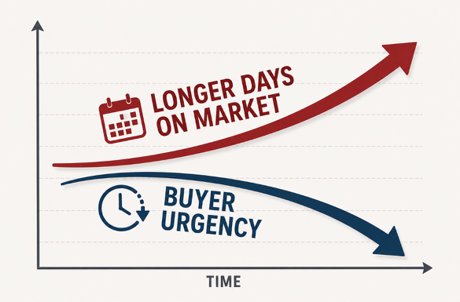
When a home sits on the market longer than expected, one of the first explanations we often hear is, "The market just isn't very good right now."
But is the market really the reason?
In most cases, we don't believe it is.
The market determines what buyers are willing to pay. Proper pricing is a reflection of the current market. If the market changes, the value of a property—and the price buyers are willing to pay—may change with it.
That doesn't mean homes aren't selling.
It means sellers have to price and prepare their properties for the market they're selling in today—not the market they remember from several years ago.
When a property isn't selling, the reason can usually be traced back to one or more of a few factors: the price is too high, the condition doesn't support the price, the home is outdated, the style or floor plan has limited buyer appeal, or the property hasn't been properly prepared for sale.
Price Is a Reflection of the Market
Every property will sell at the right price.
That doesn't mean sellers should give their property away or accept less than it's worth. Quite the opposite. Our goal is to help sellers achieve the highest price the current market will reasonably support.
But the key words are current market.
A property's market value isn't determined by what the owner paid for it, how much money has been invested in improvements, how much the seller needs to walk away with, or what a neighbor's home sold for five years ago.
Market value is ultimately determined by what today's buyers are willing to pay.
If buyers aren't scheduling showings, aren't returning for second looks, or are consistently choosing other properties, the market may be telling you something.
And if buyers are looking at the property but no one is willing to make an offer, that's feedback too.
The answer isn't necessarily that the market is bad.
The answer may be that the price doesn't accurately reflect the market.
Condition and Price Have to Make Sense Together
Not every home needs to be completely renovated before it goes on the market. In fact, we often advise sellers against making expensive improvements that may not provide an adequate return.
But buyers absolutely consider condition when deciding what they're willing to pay.
An outdated home can sell.
A home that needs repairs can sell.
A property with deferred maintenance can sell.
Even a home with significant problems can sell.
But the price has to reflect those things.
A seller can't reasonably compare an outdated property needing repairs with a similar home that has been well maintained and updated—and expect buyers to value them the same simply because they're located in the same neighborhood or have similar square footage.
Today's buyers are looking at the entire package: location, lot, construction, age, condition, updates, floor plan, style, amenities, and how much additional money and work may be required after the purchase.
The better the overall package, the more buyers may be willing to pay.
Style and Floor Plan Affect Buyer Appeal
Some properties naturally appeal to more buyers than others.
A well-designed home with a functional floor plan and a style that today's buyers find attractive will generally have a larger potential buyer pool.
Other homes may have been expanded and remodeled over the years, combining older sections with newer additions. Sometimes those changes work beautifully. Other times, they create unusual layouts, awkward transitions, or spaces that simply don't function the way many buyers would prefer.
That doesn't mean the home can't sell.
It means the market for that particular home may be smaller—and the price needs to reflect that reality.
A seller may love the way a home is designed because it works perfectly for their lifestyle. But buyers aren't purchasing the seller's memories or personal preferences. They're evaluating whether the property works for them.
Preparation Still Matters
We're also seeing sellers who want to achieve a premium price without doing the work necessary to present their property as a premium offering.
Decluttering matters.
Cleaning matters.
Removing unnecessary items and debris from inside and outside matters.
Taking care of obvious maintenance issues matters.
Making the home feel inviting matters.
We also strongly encourage sellers to consider pre-listing inspections when appropriate. Identifying problems before the property goes on the market gives sellers an opportunity to address reasonable repairs, obtain estimates for larger issues, and avoid surprises after a buyer is already under contract.
You don't have to completely renovate your home to sell it.
But if you want buyers to see maximum value in your property, you should make every reasonable effort to present it in its best possible condition.
You Have to Sell in Today's Market
One of the biggest challenges we see is sellers holding onto expectations created by the extraordinary real estate market of several years ago.
Inventory was extremely limited. Buyer competition was intense. Multiple offers were common in many markets. Some buyers were willing to overlook conditions or pay prices that would be difficult to justify today.
Markets change.
That's what markets do.
The mistake is assuming that because today's market isn't behaving exactly like the market of five years ago, the market must be "bad."
A changing market simply requires sellers to adjust.
If buyers become more selective, condition becomes more important.
If inventory increases, buyers have more choices.
If demand decreases, pricing becomes even more important.
The market isn't preventing your property from selling. The market is telling you what you need to do to sell within it.
Properties That Get It Right Are Still Selling
We continue to see properties sell when the pieces come together.
A desirable location.
A nice lot.
An appealing style.
A functional floor plan.
Good construction.
A well-maintained home.
A clean, decluttered, attractive presentation.
A seller willing to listen to professional advice.
And a price that accurately reflects current market conditions.
Those properties are a completely different story.
They attract buyers. They generate showings. They create interest. And when buyers see value compared with the other choices available to them, they act.
Not every property will sell in the same amount of time. A unique waterfront home may naturally take longer to find the right buyer than a home that appeals to a broader audience. Price ranges, locations, and property types all have different levels of demand.
But when a property isn't selling, simply blaming "the market" misses the bigger point.
Listen to What the Market Is Telling You
If your home isn't selling, take an honest look at the property and ask why.
Is the price supported by current market activity?
Does the condition support the asking price?
How does your home compare with the other properties buyers can choose from?
Is it clean, decluttered, and presented in its best possible condition?
Are there maintenance or repair issues that should have been addressed?
Does the style and floor plan appeal to a broad group of buyers—or does the price recognize that the potential buyer pool may be smaller?
And perhaps most importantly, are you listening to the professional advice of the real estate agent you've hired to help you sell?
The market is rarely the sole reason a home isn't selling.
The market establishes the conditions under which your home will sell. Your price, condition, presentation, and expectations have to reflect those conditions.
When sellers understand that—and price and prepare their properties accordingly—homes are still selling.
Because the goal isn't to sell your home in the market you wish you had.
It's to successfully sell your home in the market you have today.