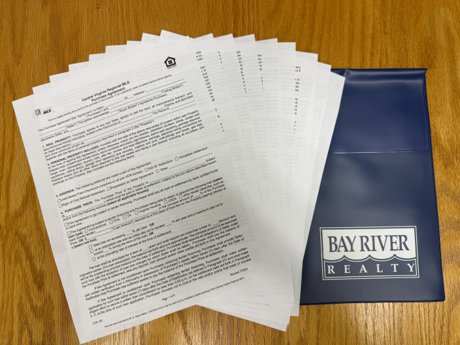
Buying or selling a home comes with a fair amount of paperwork. For many people, that’s the part of the process that feels the most overwhelming.
At Bay River Realty, we believe those documents shouldn’t feel intimidating—they should feel understandable.
Our goal is always to walk our clients through each agreement step-by-step so there are no surprises. This post is designed to give you a simple, clear overview of the most common agreements and disclosures you’ll encounter when buying or selling real estate in Virginia’s Northern Neck region.
This is not meant to be a detailed legal explanation, but rather a practical guide to help you understand what these documents are and why they matter.
If you’d like to review the actual documents, blank copies of the most commonly used forms are available on our website at www.bayriverrealty.com/resources (under Documents).
The Three Key Agreements
There are three primary agreements involved in most real estate transactions. Each one serves a different purpose, and together they form the foundation of the process.
1. Listing Agreement (For Sellers)
The listing agreement is the contract between a seller and the real estate brokerage. It gives the brokerage permission to market and sell the property.
Key items typically included:
- Listing Price
The price the property will be offered for sale, with the understanding that adjustments may be made based on market response. - Term of the Agreement
The start and end date of the listing period. - Compensation
How the brokerage is paid, including how compensation may be offered to a buyer’s agent. - Marketing Authorization
Permission for the brokerage to advertise the property through the MLS, online platforms, signage, and other marketing channels. - Seller Responsibilities
Providing accurate information and cooperating with showings and the sales process.
Why it matters:
This agreement sets clear expectations between the seller and the brokerage and outlines how the property will be marketed and represented.
2. Buyer Representation Agreement
The buyer representation agreement is the contract between a buyer and a real estate brokerage. It establishes the relationship and outlines how the agent will represent the buyer.
This agreement has become especially important in today’s real estate environment, as it clearly defines representation and compensation.
Key items typically included:
- Scope of Representation
What types of properties or areas the agreement covers. - Term of the Agreement
How long the agreement is in place. - Agent Responsibilities
Helping identify properties, schedule showings, provide market insight, and guide negotiations. - Buyer Responsibilities
Communicating honestly, working within the terms of the agreement, and coordinating efforts with the agent throughout the process. - Compensation
How the brokerage is paid for representing the buyer, and how that may be handled depending on the transaction.
Why it matters:
This agreement ensures the buyer has professional representation and a clear understanding of how their agent is working on their behalf.
3. Purchase Agreement (Contract for Purchase)
The purchase agreement is the contract between the buyer and the seller for the sale of a property.
This is the most detailed agreement in the transaction and outlines all the terms of the deal.
Key components typically included:
- Legal Names of Buyer and Seller
Identifies exactly who is involved in the transaction. - Detailed Property Description
Defines exactly what property is being conveyed, including land and any included improvements or items. - Purchase Price
The agreed-upon price for the property. - Financing Terms
Whether the buyer is paying cash or obtaining a loan, along with any related conditions. - Earnest Money Deposit
A deposit made by the buyer to show good faith in the transaction. - Contingencies
Conditions that must be met (such as inspections, appraisal, or financing approval). - Timelines & Deadlines
Key dates for inspections, loan approval, and closing. - Closing Details
When and where the transaction will be finalized. - Default Provisions
What happens if either party does not meet their obligations.
Why it matters:
This agreement serves as the roadmap for the entire transaction, outlining expectations and responsibilities for both parties.
Common Disclosures
In addition to the agreements above, there are several disclosures that may be part of a real estate transaction. These are designed to ensure that all parties have important information about the property and the relationships involved.
Not every transaction includes every disclosure, but here are some of the most common ones.
Virginia Residential Property Disclosure Statement
This disclosure provides general information about the property.
In Virginia, sellers are required to disclose any known physical defects with the property, but there is not a required checklist of items the seller needs to provide. In many cases, sellers may not be fully aware of all issues. Because of this, it is always recommended that buyers obtain a thorough home inspection and, when appropriate, a survey of the property.
Virginia is often considered more of a “buyer beware” state, meaning buyers are responsible for conducting their own due diligence.
Lead-Based Paint Disclosure
This applies to homes built prior to 1978.
It informs buyers of the potential presence of lead-based paint and includes any known information about lead hazards, along with educational materials on lead exposure. Buyers are also given the opportunity to conduct their own inspections.
Brokerage Relationship Disclosure
This document explains the different ways a real estate agent may work with buyers and sellers.
It outlines roles such as seller representation, buyer representation, dual or designated representation, and working with a buyer as a customer (non-represented).
This is especially important when a buyer is not formally represented, as it clarifies that the agent may not be acting in an advisory or advocacy role for them.
Why it matters:
It ensures everyone understands who represents whom—and what level of guidance is being provided.
Other Possible Disclosures
Depending on the property, additional disclosures may include:
- Septic and well information
- Flood zone or waterfront considerations
- Homeowners association (HOA/POA) documents, including resale certificate
- Other property-specific notices
Not every property will require all of these, but they are common in many transactions, especially in our local market.
How We Help Our Clients Through This Process
While these agreements and disclosures are important, we understand they can feel like a lot to take in.
At Bay River Realty, we don’t just send documents and ask for signatures. We take the time to walk through each agreement step-by-step, explain what the key sections mean, answer questions along the way, and help you understand how each decision impacts your situation.
Our goal is to make sure you feel informed, comfortable, and confident throughout the process.
Final Thoughts
Real estate transactions involve important documents, but they don’t have to be complicated or confusing.
When you understand the purpose behind each agreement and disclosure, the process becomes much more manageable.
If you’d like to review the full versions of these documents, you can access blank copies on our website at www.bayriverrealty.com/resources (under Documents).
If you ever have questions before signing anything, we’re always here to help walk you through it.